

Rubber Plugs
Custom Rubber Plugs Manufacturer for Industrial Sealing Applications
Chaoyue specializes in manufacturing custom rubber plugs for industrial sealing, hole blocking, and component protection applications. Based on customer drawings, samples, or technical requirements, we produce rubber plugs with customized materials, dimensions, structures, and performance specifications.
From material selection and mold development to production inspection, Chaoyue supports OEM projects for automotive components, mechanical equipment, hydraulic systems, and industrial assemblies. Samples can be provided for design verification and fit testing before bulk production, helping customers confirm dimensions, material selection, and installation requirements.


Introduction
Industrial rubber plugs provide secure sealing, masking, and port protection in manufacturing operations. Engineered for repeated use or permanent sealing, these components prevent fluid leaks, block dust, and protect threaded or plain holes during thermal processing, chemical exposure, and global shipping. Selection depends on matching elastomer types to operating temperatures, media contact, and mechanical load requirements.

Tapered Rubber Plugs: Solid conical design that fits a wide range of hole diameters. Used for powder coating, fluid painting, and general port plugging.
Pull-Type / Flanged Rubber Plugs: Features a pull tab or flange for fast manual installation and removal in high-volume masking or shipping protection.
Threaded Rubber Plugs: External or internal threads that screw directly into metric, BSP, or NPT ports to stop fluid leaks and protect threads during low-pressure testing.
Expanding Rubber Plugs: Uses a central metal screw to expand the rubber sleeve against inner pipe walls, blocking high-pressure fluids during pressure testing.
Hollow / Stopper Plugs: Thin-walled cylindrical plugs designed for low-pressure vessel capping and drainage protection.
Materials & Performance
|
Material |
Hardness |
Temperature Range |
Key Performance / Applications |
|
EPDM |
40 to 80 Shore A |
-40 °C to +150 °C |
High resistance to ozone, UV light, steam, and dilute acids; suitable for outdoor and automotive applications |
|
Silicone |
30 to 80 Shore A |
-60 °C to +200 °C |
Maintains elasticity across extreme temperatures; suitable for food and medical contact applications |
|
Neoprene (CR) |
50 to 75 Shore A |
-35 °C to +120 °C |
Balanced resistance to petroleum oils, refrigerants, and wear |
|
NBR (Nitrile) |
50 to 90 Shore A |
-30 °C to +100 °C |
Excellent resistance to hydraulic oils, gasoline, and crude oil |
Technical Specifications
|
Parameter |
Specification Range / Standard |
|
Durometer Hardness |
30 Shore A to 90 Shore A (+/- 5 tolerance) |
|
Tensile Strength |
7.0 MPa to 18.5 MPa (ASTM D412) |
|
Elongation at Break |
250% to 650% (ASTM D412) |
|
Compression Set |
Less than or equal to 25% after 22 hours at 100°C (ASTM D395) |
|
Dimensional Tolerance |
ISO 3302-1 Class M1 / M2 Precision Molding |
|
Compliance Standards |
RoHS, REACH, FDA 21 CFR 177.2600 (Silicone grades), ASTM D2000 |
Applications
Automotive
Masking engine blocks, transmission housings, and brake lines during coating cycles.
01
Hydraulics
Sealing manifold ports and cylinder fittings during shipping to block moisture and debris.
02
Chemical Piping
Temporary sealing of fuel lines and cooling ports during assembly.
03
Chemical Piping
Blanking pipe ends and vessel nozzles during pressure testing and chemical cleaning.
04
Electronics
Dust and moisture sealing for terminal access ports on outdoor enclosures.
05
Measure Hole Dimensions: Measure the inner diameter or top and bottom diameters for tapered holes. Choose a plug whose uncompressed size is 5% to 15% larger than the hole to ensure a tight, secure seal.
Check Operating Media: Identify contact fluids. Use NBR or FKM for oils, EPDM for brake fluids and water, or Silicone for high heat.
Verify Temperature Limits: Check peak operating temperatures against polymer limits to prevent hardening, softening, or permanent seal failure.
Assess Mechanical Needs: Decide if the plug is for short-term masking (easy removal) or long-term pressure sealing (high retention force).


Compounding: Closed-loop mixing ensures uniform raw material dispersion and prevents lot variance.
Molding: High-tonnage hydraulic presses with PLC temperature controls maintain uniform curing across the rubber matrix.
Deflashing: Cryogenic nitrogen deflashing removes parting line flash without damaging sealing lips.
Optical Inspection: Automated machines check critical dimensions, wall thickness, and concentricity against ISO standards.
Physical Testing: In-house labs test hardness, tensile strength, and thermal aging limits.
Custom & OEM Manufacturing

Tooling Developmen
In-house tool rooms build single and multi-cavity steel molds within 7 to 12 days after CAD drawing approval.
Custom Compounding
Tailored rubber formulas adjust hardness, color matching, flame resistance, and electrical properties.


Sample Testing
Rapid prototype samples allow for destructive testing and assembly line trials before mass production.
OEM Packaging
Custom bag labels, barcode tracking, and bulk industrial packaging match assembly line workflows.
Packaging & Delivery
Packaging Protocols
Clean polyethylene bag sealing inside master cartons prevents dust and moisture damage during ocean or air freight.
Traceability
Every master carton includes a batch label linked to raw material mill certificates and internal QC records.
Logistics Support
Direct export coordination via major ports with standard commercial invoices, packing lists, and material test reports.
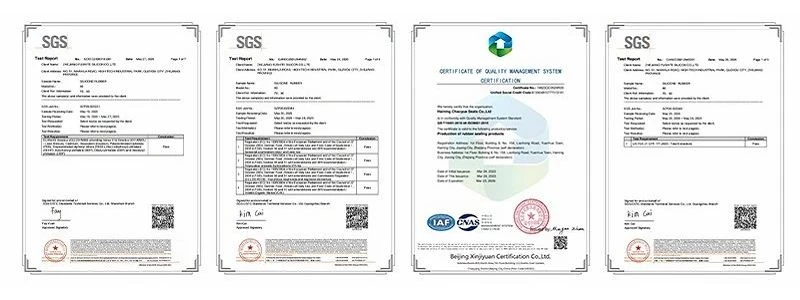
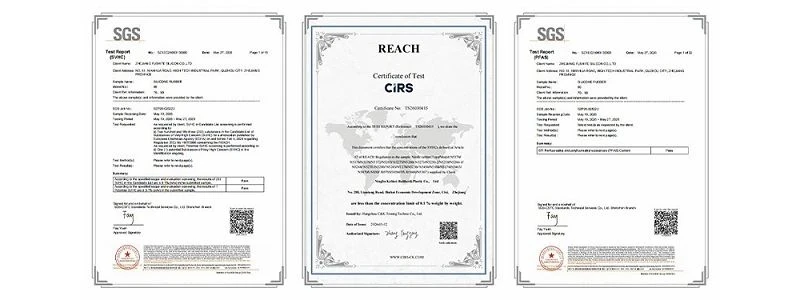
Our Certifications
FAQ
As one of the most professional rubber plugs manufacturers and suppliers in China, we offer a wide range of products with superior quality. Please feel free to wholesale high quality rubber plugs made in China here from our factory. Also, custom service is available.
rubber cone plug, rubber bung plug, silicone rubber plugs