

Fluorosilicone O Ring
Custom Fluorosilicone O-Ring Manufacturer
Chaoyue manufactures fluorosilicone O-rings (FVMQ) for sealing systems where low-temperature flexibility and resistance to fuels, mineral oils, and hydrocarbon-based fluids are required. Compared with standard silicone, FVMQ provides improved resistance to these fluid media while retaining the flexible characteristics of silicone rubber.
As a fluorosilicone O-ring manufacturer, Chaoyue supplies FVMQ sealing rings in standard and customized dimensions, with hardness and compound specifications selected according to the sealing design. Samples can be provided for dimensional and installation verification before production orders.


Introduction
Fluorosilicone O-rings (FVMQ) integrate the wide service temperature span of standard silicone with the hydrocarbon and chemical resistance native to fluorocarbon elastomers. By introducing trifluoropropyl side groups into the polymer chain, the material maintains backbone flexibility at cryogenic temperatures while resisting swelling and degradation when exposed to jet fuels, internal combustion engine oils, and synthetic lubricants. These components provide reliable static and dynamic sealing in industrial environments where operating fluids would rapidly degrade standard NBR or general-purpose silicone alternatives.
Product Types
Standard AS568 Fractional O-Rings
Molded to Aerospace Standard dimensions for uniform fit across global hydraulic and pneumatic gland designs.
Metric DIN / ISO 3601 O-Rings
Precision-sized metric cross-sections and inner diameters for European machinery and fluid power manifolds.
Custom Molded Profiles and Non-Standard Sizes
Engineered for specific hardware configurations, non-circular grooves, and specialized OEM housings.

Polymer Base: Fluorosilicone (FVMQ) with controlled vinyl-methyl-trifluoropropyl content.
Durometer Range: 50 to 80 Shore A with a plus or minus 5 tolerance.
Temperature Range: -60 degrees C to +175 degrees C continuous, withstanding intermittent exposure up to +200 degrees C.
Fluid Resistance: High resistance to aviation fuels like Jet A and JP-8, gasoline, crude oil, low aniline point oils, and synthetic diester-base lubricants.
Limitations: Lower tear and abrasion resistance compared to FKM or NBR; susceptible to degradation in polar solvents, brake fluids, and hot steam environments above 120 degrees C.
Technical Specifications
|
Property |
Test Method |
Typical Value / Specification |
|
Base Elastomer |
FTIR / DSC |
Fluorosilicone (FVMQ) |
|
Hardness |
ASTM D2240 |
70 Shore A; standard options: 50 to 80 Shore A |
|
Tensile Strength |
ASTM D412 |
Greater than or equal to 8.5 MPa |
|
Elongation at Break |
ASTM D412 |
Greater than or equal to 200% |
|
Compression Set |
ASTM D395 Method B |
Less than or equal to 25%; 22 h at 175 °C |
|
Specific Gravity |
ASTM D297 |
1.40 to 1.45 g/cm3 |
|
Volume Swell |
ASTM D471 |
0% to +10%; Fuel C, 72 h at 23 °C |
Applications
Aerospace Fuel Systems
Sealing fuel lines, carburetors, and fuel control components exposed to low temperatures and aviation fuels.
Automotive Powertrains
Crankshaft seals, fuel injector O-rings, and emission control systems operating near hot lubricants and blow-by gases.
Military Ground Equipment
Hydraulic actuators and pneumatic control valves deployed in extreme cold-weather and tactical environments.
Chemical and Petroleum Processing
Valve stems, mechanical seal faces, and pipeline instrumentation handling hydrocarbon solvents.
Define Temperature Extremes: Verify both the maximum operating temperature and the cold-start ambient minimum to ensure the compound stays within its -60 degrees C to +175 degrees C envelope.
Identify Fluid Exposure: Confirm compatibility with specific oils, fuels, or additives. Reference immersion test data to keep volumetric swell within acceptable gland fill limits, typically under 15 percent.
Determine Mechanical Load: Assess whether the application is static or dynamic. For dynamic reciprocating or rotary uses, account for the lower tear strength of FVMQ relative to standard NBR.
Select Dimensional Standard: Choose AS568 or metric dimensions matching the gland design. Calculate proper squeeze percentage (15 percent to 30 percent) and gland fill (maximum 80 percent) to prevent extrusion or over-compression.

Manufacturing and Quality Control

Compounding and Mixing: Raw FVMQ masterbatches are mixed with reinforcing fillers and organic peroxides in internal mixers under controlled shear and temperature parameters.
Compression and Transfer Molding: Precision multi-cavity steel molds mounted on hydraulic presses execute vulcanization under computer-monitored temperature and cycle times.
Defleshing and Post-Curing: Flash removal via cryogenic tumbling or precision trimming, followed by secondary oven post-curing to stabilize polymer cross-linking and eliminate volatile residues.
Dimensional and Visual Inspection: Automated optical sorting systems and manual QC checks verify inner diameter, cross-section tolerance, and surface integrity, checking for parting line mismatch, inclusions, or voids.
Batch Traceability: Every production run is logged with raw material lot numbers, cure logs, and physical property test certificates (CoA).
Custom and OEM Manufacturing
Tooling Development
In-house mold design and CNC machining of cavity tooling accommodate non-standard inner diameters, custom cross-sections, and specific hardness requirements.
Compound Customization
Formulation adjustments optimize low-temperature flexibility, tear strength, or specific regulatory compliances, such as FDA-compliant grades for food-contact processing equipment.
Prototype to Production
Rapid sampling runs support engineering validation testing before committing to high-volume multi-cavity production tooling.
Packaging and Delivery
Packaging Configuration
O-rings are counted, sealed in anti-static polyethylene bags, and boxed with desiccant to prevent environmental contamination during transit.
Labeling
Each package displays compound type, durometer, dimension, nominal quantity, curing date, and internal batch tracking barcodes.
Logistics
Standard export carton packaging secured on heat-treated wooden or plastic pallets supports ocean and air freight channels globally.
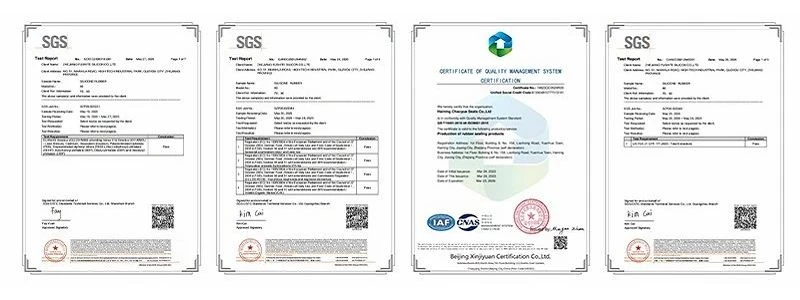
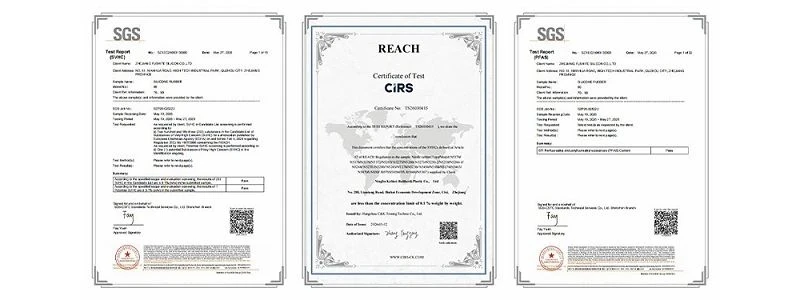
Our Certifications
FAQ
As one of the most professional fluorosilicone o ring manufacturers and suppliers in China, we offer a wide range of products with superior quality. Please feel free to wholesale high quality fluorosilicone o ring made in China here from our factory. Also, custom service is available.
Oil Resistance Fluorosilicone o ring, FVMQ O Rings, o ring