

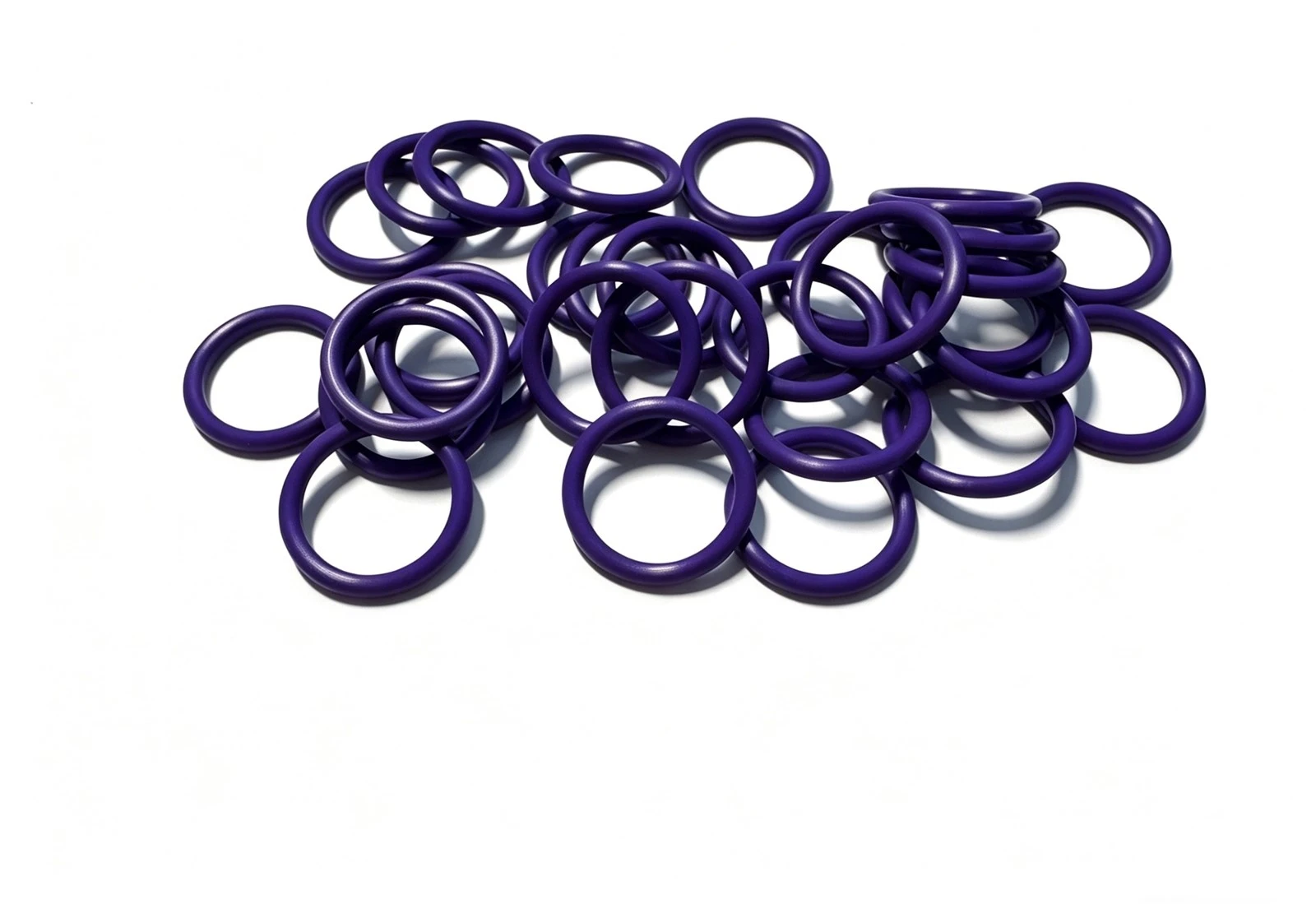
Why Manufacturer Selection Matters for Custom O-Ring Production
Custom O-ring production is not simply a matter of changing the inside diameter of a standard seal. For industrial applications, the manufacturer needs to control rubber formulation, mold dimensions, vulcanization conditions, product tolerances, and inspection standards throughout the production process.
A suitable rubber seal manufacturer should therefore be evaluated based on its ability to turn application requirements or technical drawings into consistent O-rings that perform under the specified temperature, pressure, and media conditions.
For OEM and industrial buyers, several capabilities are particularly important:
- Rubber material selection and formulation
- Custom mold development
- Dimensional control
- Batch-to-batch consistency
- Performance testing
- OEM/ODM production
- Packaging and delivery management
Start With Rubber Material Capability
The first factor to evaluate is whether the manufacturer can provide the rubber compound required for your application.
Different operating environments require different elastomers.
NBR is commonly specified for:
- Hydraulic oil
- Mineral oil
- Lubricating oil
- Fuel systems
- General industrial machinery
Its combination of oil resistance, tensile strength, and abrasion resistance makes it suitable for many hydraulic and mechanical sealing applications.
EPDM is more suitable for:
Water
Hot water
Steam
Glycol-based fluids
Outdoor environments
It provides strong resistance to ozone, UV exposure, and weather aging but is not suitable for petroleum-based oils.
FKM is selected when the sealing system requires greater resistance to elevated temperatures, fuels, oils, or certain aggressive chemicals.
Silicone is commonly used where flexibility and temperature stability are important, including certain electrical, medical, and high-temperature applications.
A manufacturer with multiple elastomer options can evaluate the actual working medium rather than forcing every application into one standard compound.
Check Custom Mold Development Capability
Custom O-rings usually require dedicated tooling when the required dimensions or cross-section differ from standard specifications.
A capable manufacturer should be able to handle:
- Customer drawing or sample review
- 2D and 3D product analysis
- Mold structure design
- Tooling production
- Trial molding
- Sample inspection
- Mold adjustment
- Mass production
Mold accuracy directly affects the O-ring's inside diameter, outside diameter, cross-section, flash, and overall geometry.
For OEM projects involving hundreds of thousands or millions of pieces, stable tooling performance is particularly important because dimensional variation can affect assembly and sealing force.
Evaluate Dimensional Tolerance Control
For a custom O-ring, the nominal size alone does not determine whether the seal will work correctly.
Important dimensions include:
- Inside diameter
- Outside diameter
- Cross-section
- Roundness
- Dimensional tolerance
These dimensions need to remain within the specified tolerance throughout production.
For example, an O-ring with an incorrect cross-section may produce insufficient compression in the groove. Excessive cross-section can increase installation force and create excessive compression.
When evaluating a manufacturer, ask how dimensional inspection is performed and how production batches are monitored.
Ask About Rubber Compound Consistency
Two O-rings with identical dimensions can behave differently if their rubber compounds have different physical properties.
Important material characteristics include:
- Hardness
- Tensile strength
- Elongation
- Compression set
- Heat aging resistance
- Chemical resistance
Hardness is commonly specified in Shore A. Many industrial O-rings use hardness grades such as 70 Shore A, 80 Shore A, or 90 Shore A depending on the application.
However, hardness alone does not define sealing performance. The complete compound formulation and curing process also affect elasticity, compression set, and long-term behavior.
A manufacturer should have a controlled material and production process to minimize variation between batches.
Consider the Vulcanization Process
Vulcanization converts the rubber compound into an elastic finished material through controlled heat and time.
This process affects:
- Hardness
- Elastic recovery
- Tensile strength
- Compression set
- Dimensional stability
Under-curing can result in insufficient physical properties, while excessive curing may affect elasticity and flexibility.
For custom O-rings, consistent vulcanization conditions are essential because even small variations can cause differences in hardness and sealing behavior between production batches.
Review the Manufacturer's Quality Inspection System
A custom O-ring supplier should have inspection procedures that cover both dimensions and material properties.
Typical inspection items include:
Dimensional Inspection
- Inside diameter
- Outside diameter
- Cross-section
- Product weight
Physical Property Testing
- Hardness
- Tensile strength
- Elongation
- Compression set
Appearance Inspection
- Flash
- Surface cracks
- Bubbles
- Contamination
- Mold defects
For applications involving specific chemicals, temperatures, or regulatory requirements, additional material or performance testing may also be necessary.
Check Standards and Certification Requirements
Industrial buyers should confirm whether the manufacturer can produce O-rings according to the required standards.
Depending on the application, common specifications may include:
- AS568
- ISO 3601
- DIN standards
- JIS standards
- Customer-specific drawings
Some projects may also require material documentation, inspection reports, or compliance with specific regulations.
The manufacturer should clearly distinguish between standard-compliant production and customer-specific requirements rather than using a general certification claim for every product.
Evaluate OEM and Small-Batch Flexibility
Not every custom O-ring project begins with a large order.
OEM customers may first require:
- Prototype samples
- Mold trials
- Small test batches
- Application testing
- Production samples
A manufacturer capable of supporting both sampling and mass production can reduce the need to change suppliers between development and commercial production.
For larger orders, production capacity and process stability become more important. The supplier should be able to maintain the same material specification, dimensions, and inspection requirements throughout repeated production batches.
Look at Application-Based Technical Support
A rubber seal manufacturer should not only manufacture according to a drawing but also understand how the O-ring will be used.
Important application information includes:
- Working pressure
- Operating temperature
- Sealing medium
- Static or dynamic sealing
- Groove dimensions
- Installation method
- Expected service conditions
For example, an O-ring used in a high-pressure hydraulic cylinder requires different considerations from one used as a static seal in an outdoor enclosure.
Technical communication during the design stage can help identify unsuitable material or dimensional combinations before mass production begins.
Custom O-Ring Production at Chaoyue
Chaoyue provides custom O-ring manufacturing for industrial and OEM applications, covering common elastomers such as NBR, EPDM, FKM, and Silicone. The production process can be based on customer drawings, samples, specified dimensions, material requirements, and application conditions.
Chaoyue's manufacturing capabilities cover compound selection, mold development, rubber molding, trimming, dimensional inspection, physical property testing, and batch quality control. This allows custom O-rings to be developed around specific sealing requirements rather than simply modifying an existing standard product.
For B2B buyers, the ability to maintain consistent dimensions and material properties across production batches is particularly important when O-rings are integrated into larger assemblies or automated production lines.
Questions to Ask Before Placing a Custom O-Ring Order
Before selecting a supplier, industrial buyers can confirm several technical points:
- Can the manufacturer work from a drawing or physical sample?
This determines whether the supplier can reproduce a non-standard O-ring accurately.
- Which rubber compounds are available?
Confirm that the supplier can provide the material required for the actual working medium and temperature.
- What dimensional tolerances can be controlled?
Tolerance requirements should be discussed before mold development and mass production.
- What testing is available?
Confirm whether the manufacturer can test hardness, tensile properties, compression set, aging, or other specified characteristics.
- Can the supplier support both samples and mass production?
This is important when an O-ring moves from prototype validation to recurring OEM orders.
Factors That Should Be Compared When Choosing a Supplier
Price is only one part of the purchasing decision. For custom O-ring production, buyers should compare manufacturers across several technical and commercial factors:
| Evaluation Factor | What to Check |
|---|---|
| Material Capability | NBR, EPDM, FKM, Silicone and other rubber compounds |
| Mold Development | Custom tooling, mold design, trial production and sample approval |
| Dimensional Control | Inside diameter, outside diameter, cross-section and dimensional tolerances |
| Quality Testing | Hardness, tensile strength, elongation, compression set and appearance inspection |
| Production Capacity | Prototype samples, small-batch production and high-volume orders |
| OEM Support | Custom drawings, physical samples, packaging, labeling and product specifications |
| Technical Support | Material selection, groove fit, operating conditions and sealing requirements |
| Batch Consistency | Stable dimensions, hardness and rubber compound properties across production batches |
Choosing a rubber seal manufacturer based on these factors gives buyers a clearer view of whether the supplier can support the complete custom O-ring production process, from initial design and sampling through repeated industrial production.