

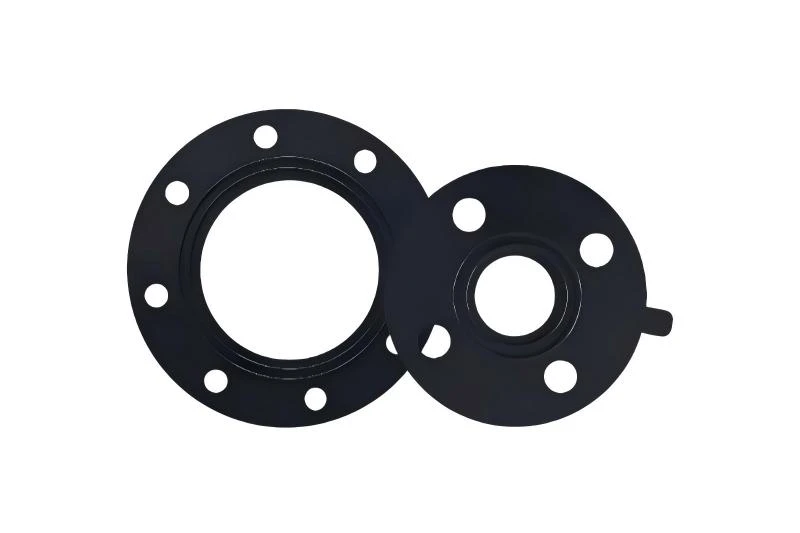
Rubber gaskets are widely used in industrial flange connections to prevent leakage between mating surfaces. They can be found in piping systems, pumps, valves, tanks, hydraulic equipment, water treatment systems, and various process equipment. Although a gasket is a relatively simple sealing component, its performance depends on the interaction between the rubber material, flange geometry, compression, working medium, temperature, and pressure.
Selecting a gasket based only on its size or material name can result in leakage, premature deterioration, or installation problems. Industrial buyers and engineers should evaluate the complete flange connection before choosing a rubber gasket. The following factors provide a practical framework for selecting a gasket according to the actual service conditions.
What Should Be Checked Before Selecting a Rubber Flange Gasket?
The first step is to understand the flange connection and the purpose of the gasket. Identify the flange type, nominal size, pressure class, sealing surface, bolt arrangement, and available gasket dimensions.
The gasket must cover the required sealing area without extending excessively into the flow path. At the same time, its outer dimensions should provide sufficient contact with the flange faces.
Before ordering, confirm:
Flange dimensions: Outside diameter, bolt-hole pattern, flange thickness, and sealing-face dimensions.
Gasket dimensions: Inside diameter, outside diameter, and thickness.
Service conditions: Working pressure, temperature, and medium.
For replacement applications, do not rely solely on the dimensions of an old gasket. Compression, swelling, deformation, or permanent set may have changed its original dimensions.
How Does Flange Design Affect Gasket Selection?
Different flange configurations create different sealing requirements. A gasket suitable for one flange arrangement may not be appropriate for another because the available compression area and surface geometry can vary.
Flat-face and raised-face flanges, for example, distribute gasket compression differently. The sealing surface may also contain machining marks or irregularities that the gasket must accommodate.
The flange's surface condition is equally important. Excessive roughness, scratches, corrosion, warping, or contamination can create leakage paths even when the gasket itself is correctly selected.
For critical applications, buyers should provide the flange drawing or relevant standard so the gasket supplier can verify the dimensional relationship between the gasket and mating surfaces.
Which Rubber Material Should Be Used for Flange Connections?
Rubber material should be selected according to the working medium and environmental conditions. Different elastomers provide different resistance to oils, water, chemicals, temperature, ozone, and weathering.
| Rubber Material | Main Characteristics | Typical Applications |
|---|---|---|
| NBR | Good resistance to many mineral oils and lubricants | Hydraulic equipment, machinery, oil-related systems |
| EPDM | Good resistance to water, weathering, ozone, and many aqueous media | Water piping, outdoor equipment, water treatment |
| FKM | Good resistance to many oils, fuels, and elevated temperatures depending on grade | Automotive and industrial fluid systems |
| Silicone | Good flexibility over a relatively broad temperature range depending on grade | Selected temperature-sensitive applications |
These are general material characteristics. Actual performance depends on the compound formulation, temperature, fluid composition, pressure, and exposure duration.
For example, EPDM may be appropriate for water service but is generally unsuitable for petroleum-based oils. NBR may be more suitable for compatible oil applications, while FKM can be considered when both chemical resistance and elevated-temperature performance are required.
How Should Temperature and Pressure Be Evaluated?
Temperature and pressure are two of the most important operating parameters when selecting a rubber gasket. Elevated temperatures can accelerate elastomer aging, while low temperatures may reduce flexibility and affect sealing contact.
Pressure can place additional mechanical demands on the gasket. At higher pressure, the rubber may deform toward clearance gaps between the flange surfaces. The risk depends on gasket hardness, material properties, flange clearance, compression, and the overall connection design.
When requesting a gasket, specify:
- Normal operating temperature
- Minimum and maximum temperature
- Normal working pressure
- Potential pressure fluctuations or peaks
- Whether pressure is internal or external
- Frequency of pressure and temperature cycling
Do not use a generic pressure or temperature value as a guarantee of performance. The complete flange design and selected rubber compound should be evaluated together.
What Gasket Thickness Is Suitable for an Industrial Flange?
Gasket thickness affects compression, bolt loading, deformation, and the ability to accommodate flange-surface irregularities. A thicker gasket is not automatically a better sealing choice.
If the gasket is too thick for the connection design, it may require greater compression and can experience excessive deformation. If it is too thin, it may not adequately compensate for small surface irregularities or dimensional variation.
The appropriate thickness depends on the flange design, sealing surface, rubber hardness, bolt loading, and application requirements. For standardized flange connections, buyers should follow the relevant engineering specification rather than selecting thickness based only on previous purchasing experience.
How Important Are Flange Surface Condition and Bolt Load?
A rubber gasket requires appropriate compression to establish contact with the mating flange surfaces. Bolt load must therefore be sufficient and reasonably distributed across the connection.
Uneven tightening can create areas with insufficient compression and increase the possibility of leakage. Excessive tightening can also damage the gasket or distort the flange.
Before installation, flange faces should be clean and free from foreign particles, excessive corrosion, and sealing-surface damage. Bolts should be tightened according to the equipment manufacturer's procedure or applicable engineering requirements, generally using a controlled and balanced tightening sequence.
A gasket cannot compensate indefinitely for a damaged flange or inadequate assembly procedure.
Should the Gasket Be Selected According to the Working Medium?
Yes. Chemical compatibility should be treated as a primary selection criterion rather than a secondary consideration.
Water, mineral oil, fuel, compressed air, refrigerants, acids, alkalis, and process chemicals can interact differently with rubber compounds. Incompatible exposure may cause swelling, shrinkage, hardening, softening, cracking, or loss of compression.
When selecting a gasket, identify the exact medium and, where relevant, its concentration and temperature. Also consider cleaning chemicals and process fluids that may contact the gasket during maintenance.
For unfamiliar chemicals or demanding applications, review material compatibility data and conduct application-specific testing before approving the gasket for production use.
When Are Custom Rubber Flange Gaskets Necessary?
Standard flange gaskets are generally suitable when the flange dimensions and operating conditions match an established product specification. Custom gaskets become useful when the connection has non-standard dimensions or requires a particular material, thickness, shape, or bolt-hole arrangement.
Customization may involve:
- Non-standard inside or outside diameters
- Special thicknesses
- Custom bolt-hole patterns
- Different flange profiles
- Specific rubber compounds or hardnessSpecial shapes for equipment housings and process systems
For custom orders, technical drawings and flange samples provide more useful information than a simple product description. The supplier can use these details to evaluate dimensions, tooling requirements, and production feasibility.
How Can Buyers Match Gasket Dimensions With Flange Standards?
Flange standards provide an important reference for dimensional compatibility. Depending on the industry and market, flange connections may follow different standards covering dimensions, pressure ratings, bolt patterns, and sealing surfaces.
Buyers should confirm the applicable flange standard and nominal size before ordering. Similar nominal pipe sizes do not necessarily mean that every flange or gasket is interchangeable.
A purchase specification should therefore identify the flange standard, nominal size, pressure class where applicable, gasket type, dimensions, material, and thickness. This reduces the risk of receiving a gasket with a correct-looking diameter but an incompatible bolt-hole pattern or sealing area.
What Common Mistakes Should Buyers Avoid?
Several common mistakes can affect flange gasket performance.
Selecting by size alone can overlook temperature, pressure, and fluid compatibility. A gasket may fit the flange but deteriorate quickly when exposed to an unsuitable medium.
Ignoring flange condition can lead to leakage even when the gasket material is appropriate. Deep scratches, corrosion, deformation, and contamination may prevent uniform sealing.
Using excessive bolt force can damage the gasket and potentially distort the flange. Proper tightening procedures are therefore part of the sealing system.
Skipping sample or application validation is another risk for non-standard connections. Where operating conditions are demanding, testing should be completed before large-scale procurement.
What Information Should Be Included in a Rubber Gasket Purchase Order?
A detailed purchase specification helps both the buyer and supplier understand the required product.
The order should normally include the flange standard and size, gasket dimensions, thickness, rubber material, hardness where specified, operating temperature, working pressure, and working medium. For custom gaskets, drawings should clearly identify critical dimensions and tolerances.
Buyers should also define inspection requirements, packaging, quantity, sample approval, and any required quality documentation. If the gasket is a replacement component, the original part number and equipment application can provide additional reference information.
Providing complete specifications at the quotation stage can reduce repeated confirmation and avoid unnecessary sample revisions.
How Should Rubber Flange Gaskets Be Validated Before Mass Ordering?
Sample validation is particularly important for custom gaskets or applications involving high temperature, pressure, chemical exposure, or frequent operating cycles.
First, check the gasket's dimensions, thickness, hardness, and visual condition against the approved specification. Then install the gasket on the actual or representative flange to confirm alignment with bolt holes and the sealing surface.
Where necessary, evaluate leakage performance under representative pressure, temperature, and working-medium conditions. For long-term applications, consider whether repeated temperature or pressure cycles could affect compression and material properties.
Once the sample is approved, keep the approved drawing, material specification, and inspection criteria as the reference for subsequent production batches.