

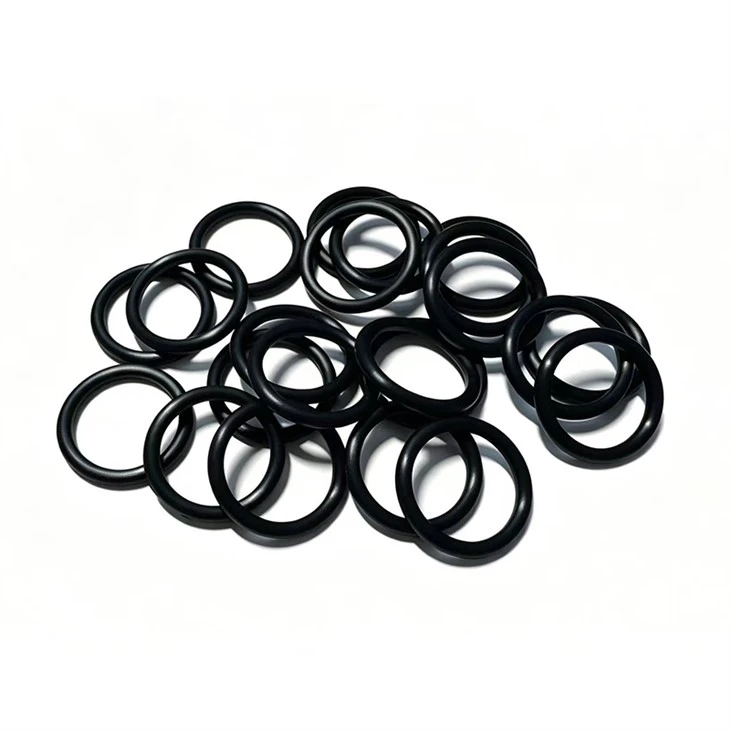
Sealing Principle
Fluorine Rubber O Ring works based on elastic deformation and contact pressure.
During installation:
The O Ring is compressed inside the groove.
The rubber material generates restoring force due to elastic deformation.
The contact pressure between O Ring and sealing surfaces becomes higher than the system pressure.
The compressed rubber blocks the movement of liquid or gas through the clearance gap.
For static applications, sealing performance mainly depends on:
Groove dimension
Compression ratio
Rubber hardness
Surface finish of mating parts
Typical compression range:
| Application | Recommended Compression |
|---|---|
| Static axial seal | 15%-30% |
| Static radial seal | 20%-35% |
| Dynamic seal |
10%-20%
|
Pressure Conditions
The O Ring itself provides sealing through deformation. For higher pressure systems:
Backup rings may be required
Groove clearance must be controlled
Material hardness may need adjustment
Typical industrial applications use FKM O Rings in:
Hydraulic systems
Fuel systems
Valve assemblies
Pump sealing structures

| Structure Part | Function |
|---|---|
| Circular cross-section | Provides uniform sealing contact around the circumference |
| Elastomer body | Deforms under compression to fill surface irregularities |
| Sealing surface | Contacts housing and shaft/flange surfaces to block fluid leakage |

WHY CHOOSE US?
Advanced Technology:
Equipped with state-of-the-art production facilities and a skilled R&D team.
Customization Capabilities:
Tailored solutions designed to fit your specific requirements.
Global Reach:
Dedicated to serving clients across the world with reliable products and exceptional service.
Proven Experience:
Decades of industry leadership and a commitment to continuous innovation.
FAQ:
What is Fluorine Rubber O Ring?
It is a circular sealing component manufactured from fluorocarbon rubber (FKM/FPM). It seals by elastic deformation inside a machined groove.
What is the difference between FKM and NBR O Ring?
The main difference is polymer structure. FKM contains fluorinated polymer chains, providing higher resistance to fuel, chemicals, and heat. NBR provides better low-temperature flexibility and lower cost.
What temperature can FKM O Ring withstand?
Standard FKM O Rings typically operate from -20°C to +200°C. Specific compounds may extend the temperature range.
How is FKM O Ring installed?
The O Ring is placed into a designed groove. During assembly, the mating component compresses the O Ring, creating contact pressure that prevents fluid leakage.


