

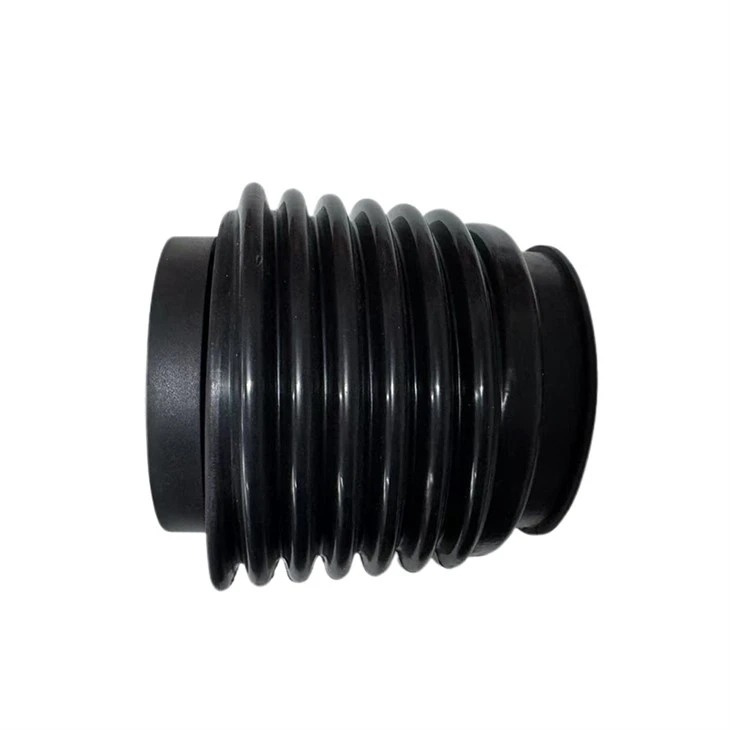
Automotive Rubber Bellows Protection
- Contaminant Barrier
The bellows forms a flexible enclosure around the protected component, limiting the entry of dust, mud, sand, and other road contaminants.
- Water & Road Splash Protection
The closed corrugated body helps shield internal components from water and splash exposure during vehicle operation.
- Joint & Shaft Protection
It can cover moving shafts, joints, linkages, and connection points that require protection while remaining capable of movement.
- Protection During Repeated Operation
The bellows maintains coverage while the protected component changes position, reducing direct exposure of the assembly to the surrounding environment.

Automotive Rubber Bellows Flexibility & Movement
- Compression & Extension
The convoluted body allows the bellows to shorten and extend as the connected automotive components change their relative position.
- Angular Movement
Individual folds deform progressively during bending, allowing the bellows to accommodate angular displacement without requiring a rigid enclosure.
- Repeated Flexing
The corrugated profile distributes deformation across multiple folds rather than concentrating movement at a single section.
- Movement Clearance
Bellows dimensions and convolution geometry can be configured around the required stroke, bending angle, and available installation space.
Automotive Rubber Bellows Manufacturing Capability
Molded Rubber Production
Chaoyue manufactures molded rubber bellows with controlled corrugation profiles, end dimensions, wall sections, and overall geometry.
Multi-Compound Material Capability
Different rubber compounds can be processed according to the required temperature range, fluid exposure, ozone conditions, and mechanical demands.
Prototype to Batch Production
Customer samples or drawings can be developed into production tooling, followed by trial samples and repeat batch manufacturing after specification approval.
OEM Component Supply
Chaoyue supports automotive component manufacturers and industrial buyers with customized bellows, specification control, and repeat-order production.
FAQ
Which automotive components can use rubber bellows?
They can be used around moving or exposed components such as steering joints, suspension linkages, drive components, shafts, and mechanical connections. The bellows dimensions and movement requirements need to match the specific assembly.
How do I determine the correct bellows size for an automotive component?
Measure the required installation length, maximum and minimum working length, connection diameters, available radial space, and expected movement. For custom development, a component drawing or existing sample is useful.
How does the number of convolutions affect bellows performance?
The number and geometry of convolutions influence how the bellows accommodates compression, extension, and bending. More folds can distribute movement across a longer flexible section, while the actual design depends on the required stroke and installation space.
Can automotive rubber bellows accommodate both axial and angular movement?
Yes. A properly designed corrugated profile can accommodate axial compression or extension together with angular deflection. The allowable movement should be established from the bellows geometry and connected component motion.


