

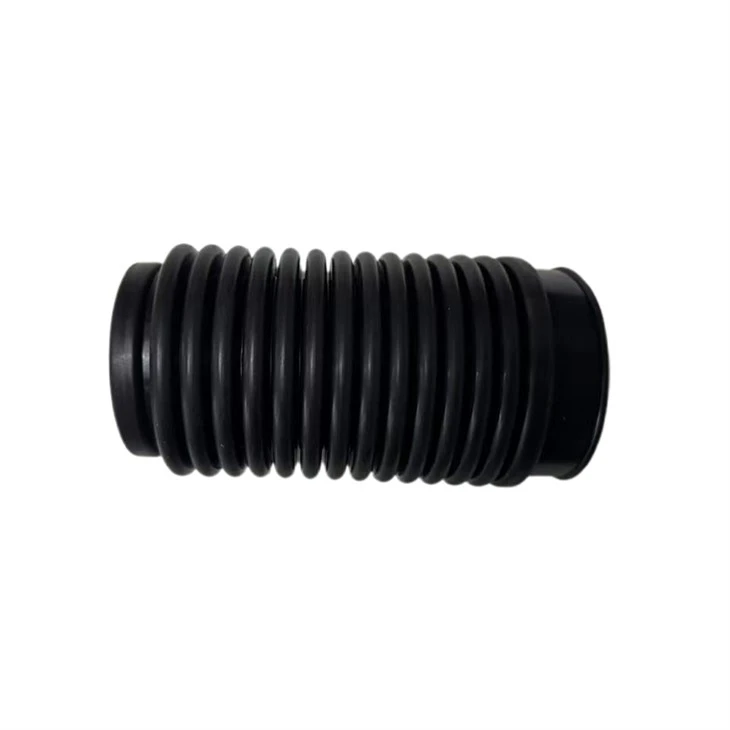
Corrugated Rubber Bellows Performance Features
- Axial Flexibility
The corrugated structure allows controlled compression and extension during axial movement without requiring a rigid protective cover.
- Bending Capability
Multiple convolutions allow the bellows to follow limited angular movement of connected components while reducing localized bending stress.
- Repeated Movement
The flexible wall structure is designed for repeated movement cycles, with the number and geometry of convolutions affecting the available travel and flexing behavior.
- Protective Coverage
The bellows covers exposed shafts, rods, joints, and moving components to reduce direct exposure to dust, debris, and other external contaminants.
- Shape Recovery
Suitable rubber compounds provide elastic recovery after compression or extension, helping the bellows return toward its original profile during repeated operation.

Custom Corrugated Rubber Bellows Design
Custom Bellows Dimensions
Inside diameter, outside diameter, overall length, wall thickness, and number of convolutions can be adjusted to match the available installation space and required movement.
Custom Corrugation Profiles
Corrugation height, spacing, shape, and pitch can be designed according to the required compression, extension, and bending movement.
Custom End Connections
Open ends, clamping sections, flanges, stepped ends, and other mounting structures can be produced according to customer drawings or samples.
FAQ
What clearance should be allowed around a rubber bellows?
Sufficient clearance should be provided around the bellows to prevent contact with nearby brackets, housings, fasteners, or moving components throughout the complete operating stroke.
Can a rubber bellows be used in continuous reciprocating motion?
Yes, depending on the movement frequency, stroke, bending angle, installation condition, and selected rubber compound. These operating parameters should be confirmed when designing the bellows.
How does installation affect bellows service life?
Incorrect installation can introduce twisting, excessive stretching, or localized compression. The bellows should be installed without torsional preload and should remain aligned with the protected component during operation.
Can the bellows be exposed to lubricating grease or hydraulic oil?
This depends on the rubber compound and the specific fluid. The lubricant type, temperature, and exposure conditions should be provided so material compatibility can be evaluated before production.


