

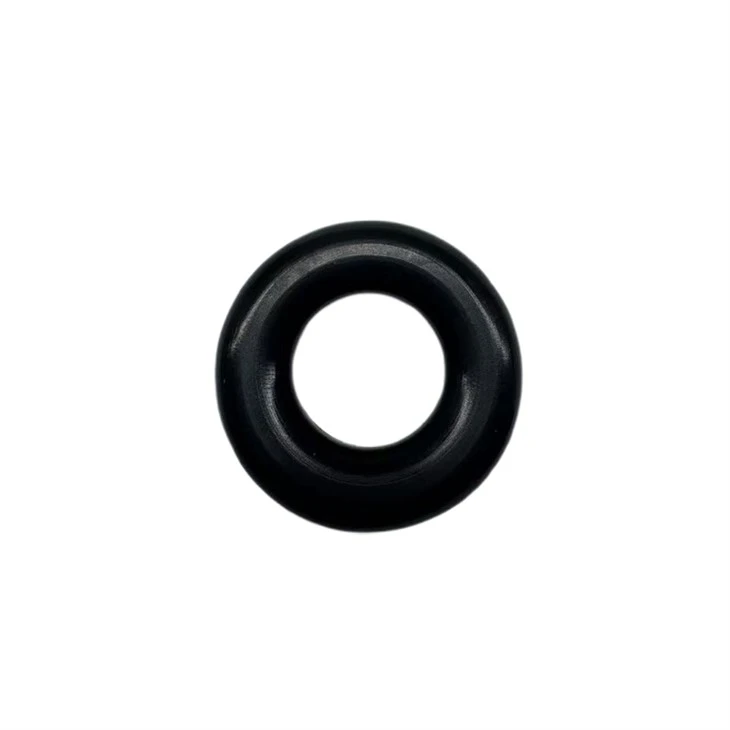
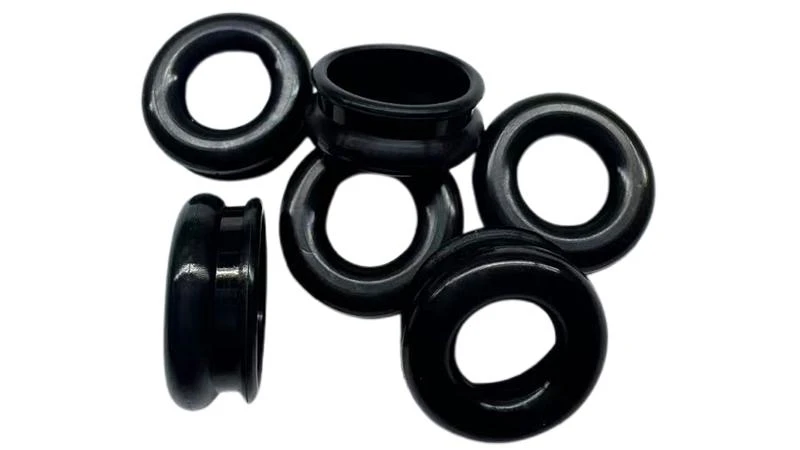
Chaoyue Rubber Cable Grommets feature a molded rubber body with a central cable opening, outer retaining flange, and peripheral mounting groove. The central opening accommodates the cable, while the surrounding rubber wall separates the cable insulation from the edges of the panel cutout. The outer flange covers the opening perimeter, and the retaining groove secures the component against the panel edge.
The molded profile can be configured with different bore diameters, wall thicknesses, flange widths, and groove geometries to match specific installation structures. Depending on the product design, the inner opening can be produced in different shapes and sizes to accommodate individual cable dimensions. The rubber contact surface also provides a flexible interface that helps reduce direct friction between the cable and the surrounding metal or plastic panel.
Panel Fit & Dimensional Compatibility
Chaoyue develops cable grommet dimensions according to the actual mounting structure and cable specifications. The outer profile, retaining groove, and central opening are coordinated to achieve proper engagement with the panel and suitable clearance around the cable.
Key dimensions available for specification include:
- Inner Diameter: Customized according to the cable outside diameter.
- Outer Diameter: Adjusted to match the mounting hole.
- Groove Width: Designed according to the panel thickness.
- Groove Depth: Configured to achieve the required panel engagement.
- Flange Diameter: Adjusted to provide the required coverage around the cutout.
- Body Thickness: Specified according to the required structural profile and available space.
For non-standard applications, Chaoyue can manufacture components according to customer drawings or physical samples. Critical dimensions and tolerances can be defined in the product drawing to support dimensional verification during production.
Customization & Manufacturing Capability
Custom Profile Design
Central bore dimensions, flange shapes, retaining grooves, body thicknesses, and overall profiles can be modified according to customer drawings or samples.
Compound & Hardness Customization
NBR, EPDM, FKM, CR, and silicone compounds are available for specification-based development. Rubber hardness and compound formulation can be selected according to the required product characteristics.
Mold Development
Dedicated molds can be developed for non-standard dimensions and special structural profiles. Mold geometry is established according to approved drawings and sample requirements.
Sample & Production Verification
Initial samples can be evaluated for dimensional accuracy, mounting fit, cable opening dimensions, and molded appearance. Approved specifications are then used as the reference for subsequent production inspection.
Rubber Material & Hardness Selection
Chaoyue Rubber Cable Grommets can be manufactured using different rubber compounds to meet specific product specifications. Material options include:
|
Material |
Characteristics in Grommet Production |
|---|---|
|
NBR |
Suitable for oil-exposed applications, with good flexibility and abrasion resistance |
|
EPDM |
Suitable for outdoor and moisture-exposed applications, with ozone and weathering resistance |
|
FKM |
Suitable for applications requiring resistance to many oils, fuels, and chemical media |
|
Silicone |
Offers flexibility across a broad temperature range and a soft contact surface |
|
CR |
Provides balanced weathering, ozone, and moderate oil resistance |
FAQ
Can multiple cables pass through one grommet?
Yes. Multi-hole configurations can be developed to accommodate several cables within one molded component. The number, diameter, and spacing of the openings can be specified according to the cable arrangement and available mounting space.
Can a custom grommet be manufactured from an existing sample?
Yes. Chaoyue can use an existing physical sample as a reference for product development. Key dimensions, molded profiles, material characteristics, and installation details can be evaluated before preparing a production drawing and tooling plan.
What information is needed to request a quotation?
Buyers can provide a 2D drawing, 3D model, or physical sample. It is also helpful to specify the required quantity, rubber material, hardness, and any special appearance or dimensional requirements. These details help determine the tooling and production specifications.
Are these components suitable for automated assembly?
They can be supplied for manual or automated assembly, depending on the component geometry and installation process. For automated applications, dimensional consistency, part orientation, feeding requirements, and insertion conditions should be confirmed during sample evaluation.


