


Bellows Construction
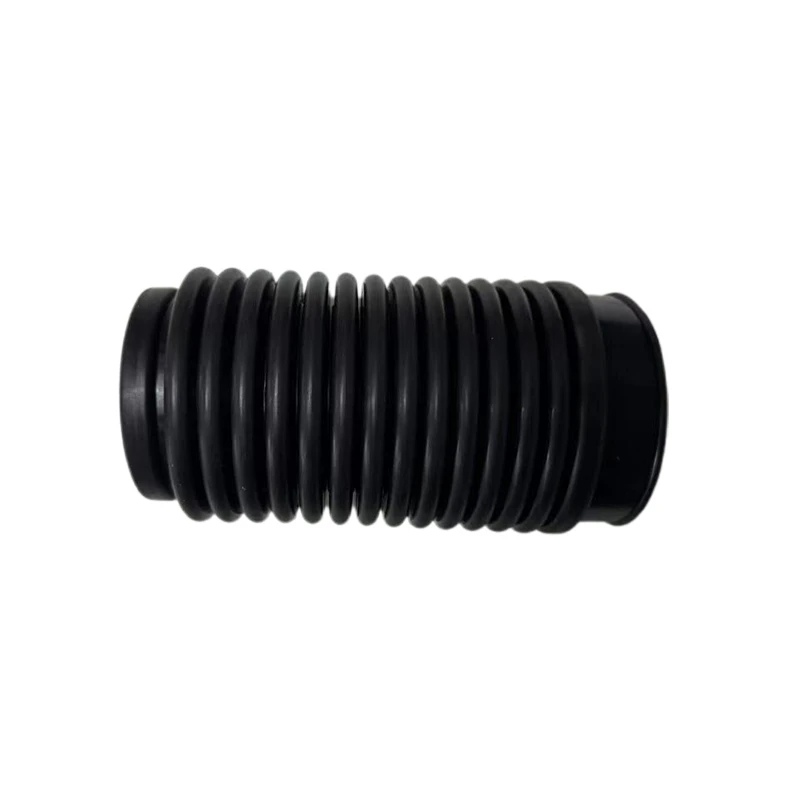
The bellows is formed as a continuous molded rubber body with flexible convolutions between its two connection ends. Each structural section contributes to controlled deformation while maintaining the required clearance around the protected component.
- Convoluted Body - Repeated curved sections provide the flexible wall geometry required for controlled expansion, compression, and bending.
- Transition Sections - Gradual transitions between convolutions help distribute deformation along the bellows rather than concentrating movement at one point.
- End Sections - The two ends can incorporate different diameters, steps, grooves, or mounting profiles according to the connected components.
- Internal Clearance - The internal cavity can be developed around the moving component to provide sufficient clearance during its working stroke.
The rubber compound should be selected according to the fluids, temperature, weather exposure, and mechanical conditions surrounding the bellows. Different materials provide different resistance characteristics and should be matched to the actual service environment.
- NBR - Commonly considered where the bellows is exposed to mineral oils, grease, and general mechanical fluids.
- EPDM - Suitable for applications involving water, moisture, ozone, weathering, and outdoor exposure where oil resistance is not the primary requirement.
- Silicone / VMQ - Can be selected where flexibility and temperature adaptability are important, including selected electrical insulation applications.
- FKM - Considered for environments involving oils, fuels, and selected chemicals where higher fluid resistance is required.
Custom Flexible Rubber Bellows Manufacturing
Chaoyue develops custom rubber bellows around the movement range, installation space, and connection requirements of the customer's assembly. Product development can be based on drawings, samples, CAD data, or mating components.
- Convolution Geometry - Convolution height, pitch, quantity, and overall profile can be developed according to the required movement and available installation space.
- End Configuration - Different end diameters, stepped sections, grooves, and mounting interfaces can be incorporated into the same bellows design.
- Dimensional Development - Overall length, internal clearance, wall profile, and critical mounting dimensions can be established according to the approved specification.
- Sample-Based Production - Existing bellows can be evaluated as references for profile development, tooling preparation, sample approval, and subsequent batch production.
FAQ
Can the two ends of a rubber bellows have different connection sizes?
Yes. Different end diameters or connection profiles can be incorporated when the connected components require different interfaces.
How can I prevent a bellows from being overstretched during installation?
The installation should keep the bellows within its specified working position and movement range. Excessive extension, compression, or twisting during assembly can place additional stress on the convolutions.
Can a rubber bellows operate in a partially compressed position?
It can, provided the installed position and working stroke remain within the design limits. The available installation length and required movement should be reviewed during product selection.


